The Difference Between Sphynx and Elf Cats
Sphynx vs Elf Cats: What’s the Difference?
History, appearance, temperament, health and the truth about those curled ears
If you have ever seen a Sphynx and an Elf cat side by side, the most obvious difference is easy to spot.
The ears.
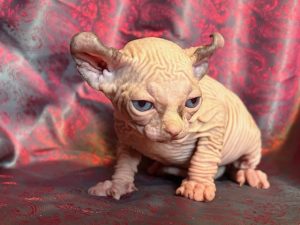
A Sphynx has the wonderfully large, upright ears the breed is famous for, while an Elf has distinctive ears that gently curl backwards.
But underneath those ears, the two are much more alike than they are different.
Elf cats were developed using the Sphynx and American Curl, with subsequent generations bred back towards Sphynx type. This means that in established Elf lines, the American Curl outcross may sit generations back in the pedigree.
The result is essentially the personality, body type and wonderful hairless characteristics people love about the Sphynx — with the addition of those unmistakable curled ears.
So, what actually separates a Sphynx from an Elf? And are there additional health concerns associated with the Elf ear?
Let’s take a closer look.

The History of the Sphynx
Despite the name and their rather ancient-Egyptian appearance, the modern Sphynx did not originate in Egypt.
Hairlessness in cats is a naturally occurring genetic mutation, and hairless kittens have appeared spontaneously in domestic cat populations at different points in history.
The foundations of the modern Sphynx breed developed primarily in North America during the twentieth century.
One important event occurred in Toronto, Canada, in 1966, when a domestic cat gave birth to a naturally hairless kitten. Other naturally occurring hairless cats were subsequently identified and incorporated into breeding programs.
Breeders carefully developed the Sphynx while also using outcrosses to maintain genetic diversity.
Over generations, cats were selected for the characteristics that eventually became associated with the modern Sphynx:
- a substantial, muscular body
- broad chest
- rounded abdomen
- prominent cheekbones
- large expressive eyes
- very large upright ears
- long, dexterous toes
- soft, warm, suede-like skin
- an outgoing, people-focused temperament
Although commonly described as completely hairless, many Sphynx actually have an extremely fine covering of down.
Some feel like warm suede.
Others feel more like a peach.
And some are almost completely naked.
So Where Did the Elf Cat Come From?
The Elf is a much newer development.
Breeders wanted to retain the distinctive hairless appearance and temperament of the Sphynx while introducing the unusual curled ear found in the American Curl.
The American Curl itself also began with a naturally occurring mutation.
Its characteristic ears curve backwards rather than folding forwards.
By introducing the American Curl ear trait into Sphynx lines and then breeding subsequent generations back towards Sphynx, breeders developed what we now know as the Elf.
This is an important part of understanding modern Elf cats.
An established Elf is not simply a first-generation Sphynx × American Curl cross.
In established pedigrees, the original American Curl contribution can be many generations behind the kittens being produced today.
The breeding focus over those generations is towards maintaining:
- Sphynx body type
- hairlessness
- temperament
- health
- structure
- and the distinctive curled ear.
That is why a well-bred Elf should look overwhelmingly like a Sphynx — just with a different ear shape.
The American Curl: Where the Elf Ear Comes From
The American Curl breed traces its history to California in the early 1980s.
A stray black female with unusual backward-curled ears became the foundation of the breed when she later produced kittens displaying the same characteristic.
The trait was found to be inherited.
Importantly, the American Curl developed with considerable genetic diversity because domestic cats were historically used as outcrosses during development of the breed.
The American Curl has generally proven to be a robust and hardy cat.
And that matters when we talk about Elf health.
Does the Elf Ear Cause Health Problems?
This is probably the question we are asked most frequently about Elf cats.
The short answer is: there is no established systemic health disorder associated with the American Curl ear trait.
Elf cats are generally hardy, active and athletic cats when responsibly bred.
The American Curl outcross used to establish the Elf was not introducing a breed known for widespread skeletal disease. In established Elf lines, that outcross is also often generations back.
The curled ear itself is a physical characteristic.
It does not mean that the cat’s entire skeletal system has abnormal cartilage.
This is particularly important because people sometimes assume an Elf must have the same health concerns as a Scottish Fold.
It doesn’t.
An Elf Is Not a Scottish Fold
These two ear traits are sometimes incorrectly grouped together simply because both result in unusual-looking ears.
Genetically, however, they are very different.
Scottish Fold
The Scottish Fold ear folds forward and downward.
The mutation responsible affects cartilage throughout the body and is associated with osteochondrodysplasia, a condition that can affect bones, joints and mobility.
That is why the Scottish Fold mutation raises significant welfare concerns.
American Curl and Elf
The American Curl ear curves backwards.
It is produced by a different genetic mechanism and has not been associated with the systemic cartilage disease found in Scottish Fold cats.
So:
Curled ears do not automatically mean unhealthy cartilage.
The direction in which an ear bends isn’t what determines health.
The underlying genetics do.
And the genetics behind the Elf/American Curl ear and the Scottish Fold ear are different.
Are Elf Cats Healthy?
A well-bred Elf should be a healthy, energetic and robust companion.
There is no recognised additional systemic disease that we expect simply because an Elf has curled ears.
However, that does not mean that an Elf — or any breed of cat — can never develop a health problem.
Because Elf cats are predominantly Sphynx in type and ancestry, we consider the health issues relevant to Sphynx cats when developing responsible Elf breeding programs.
The most important of these is:
Hypertrophic Cardiomyopathy — HCM
Hypertrophic cardiomyopathy is a condition in which the muscular walls of the heart become abnormally thickened.
HCM occurs across the general cat population but has an inherited component in a number of breeds, including the Sphynx.
That is why responsible Sphynx and Elf breeding programs should include regular echocardiographic HCM screening of breeding cats.
There are genetic tests associated with some HCM risk in Sphynx, but DNA testing alone cannot guarantee that a cat will or will not develop HCM.
For this reason, heart scanning remains an extremely important part of responsible breeding.
The important distinction is:
HCM is a Sphynx-related breeding consideration — it isn’t a disease caused by the Elf ear.
What About the Shape of an Elf’s Ear?
An Elf kitten isn’t necessarily born looking exactly like the adult cat it will become.
The curl develops as the cartilage matures.
Some kittens develop a stronger curl.
Others have a more gentle arc.
That variation is part of their individuality.
The ear should form a smooth backwards curve rather than appearing distorted or tightly folded.
And because the cartilage has its own natural shape, Elf ears should always be handled gently.
There is no reason to:
- straighten them
- bend them
- repeatedly manipulate the curl
- or force the ear into another position.
Simply allow the ear to sit naturally.
Do Elf Cats Need Special Ear Care?
Not really.
Both Sphynx and Elf cats can accumulate noticeable ear wax because they lack the normal amount of hair around the ear canal.
Routine ear care is therefore part of living with either variety.
For an Elf, the main consideration is simply working with the natural shape of the ear rather than against it.
Only clean areas you can safely reach and never force cotton buds or cleaning implements deep into the ear canal.
Their curled ears may look delicate, but they are not something owners need to be frightened of touching.
Gentle, normal handling is perfectly appropriate.
Sphynx and Elf Temperament
This is where Sphynx and Elf owners usually become extremely enthusiastic.
These are not cats that simply happen to live in your house.
They tend to become involved in it.
Very involved.
Both Sphynx and Elf cats are commonly:
- highly affectionate
- intelligent
- curious
- confident
- playful
- people-focused
- mischievous
- social
- trainable
- physically active.
Many want to know exactly what their humans are doing.
Opening a cupboard?
They’ll investigate.
Making the bed?
They’re helping.
Taking a shower?
They may supervise.
Opening a parcel?
Clearly it belongs to them.
Sitting down?
Apparently you have just volunteered as a heated cat bed.
They Are Often Exceptionally People-Oriented
One of the defining characteristics we value in both Sphynx and Elf cats is their connection with people.
Many actively seek physical contact and warmth.
They may sleep:
- under blankets
- against your chest
- behind your knees
- on your shoulders
- underneath your jumper
or directly in whichever position is least convenient for you.
Many also greet visitors enthusiastically and can thrive in active households when properly socialised.
However, temperament isn’t created by breed alone.
It is influenced by:
genetics + early development + socialisation + learning + environment.
A genetically confident kitten raised in a rich, positive environment has an enormous advantage.
Intelligence and Training
Both Sphynx and Elf cats can be exceptionally trainable.
They tend to be naturally curious and highly motivated by interaction, food or play.
With positive reinforcement, they can learn behaviours such as:
- sit
- stay
- recall
- touch
- spin
- fetch
- harness walking
- jumping through hoops
- using a cat wheel
- target training
- agility behaviours
- tricks.
Training isn’t simply entertainment.
It can also improve:
confidence, communication, handling tolerance, enrichment and the human-cat relationship.
A mentally stimulated Sphynx or Elf is usually a much happier cat.
Is an Elf More Playful Than a Sphynx?
Not necessarily.
There isn’t a reliable rule that says:
Elf = more active
Sphynx = calmer
Individual temperament matters far more.
Within the same litter you can have one kitten who wants to explore everything and another whose greatest ambition is to spend its life under your blanket.
Both varieties can be athletic, playful cats.
They often enjoy:
- climbing
- interactive toys
- puzzle feeders
- cat wheels
- tunnels
- high platforms
- training
- exploration
- play with other cats.
They generally do best in homes where they are considered part of the family rather than decorative pets.
Do Sphynx and Elf Cats Need Different Grooming?
Very little separates them here.
Neither has a normal coat to absorb skin oils, so routine maintenance can include:
Skin
Some individuals accumulate more oil than others.
How frequently a Sphynx or Elf needs bathing varies enormously.
Over-bathing can sometimes cause just as many problems as under-bathing because excessive washing can interfere with the skin’s natural balance.
Nails
Oil and debris can accumulate around the nail bed, so regular nail checks and cleaning are useful.
Ears
The lack of hair around the ears often makes normal wax more visible.
Gentle cleaning may therefore be required.
Warmth
Hairless cats naturally seek warmth.
Warm bedding, blankets and comfortable indoor temperatures are important.
Sun
Hairless skin can be vulnerable to excessive sun exposure.
These cats should not spend long periods exposed to harsh direct sunlight.
Is a Sphynx or an Elf Better for Families?
There isn’t a simple winner.
Both can make outstanding family companions.
The better question is:
Which individual kitten’s temperament suits your household?
A confident kitten may suit:
- an active family
- children
- other cats
- appropriately introduced dogs
- travelling
- harness adventures
- training.
A quieter kitten may be better suited to:
- a calm household
- a single person
- someone wanting a particularly cuddly companion.
This is why matching kittens purely by colour, sex or ear type doesn’t always produce the best outcome.
Temperament matters.
The prettiest kitten in the litter isn’t automatically the right kitten for every family.
Should I Choose a Sphynx or an Elf?
If everything else is equal, it often comes down to appearance.
Choose a Sphynx if you love:
The classic Sphynx appearance with those enormous upright ears and striking expression.
Choose an Elf if you love:
The Sphynx look but find those whimsical backward-curled ears irresistible.
From a companion perspective, you are much more likely to notice the personality of the individual cat than a dramatic behavioural difference between the two.
Both can become incredibly affectionate, intelligent and entertaining family members.
Common Myth: “Elf Cats Have More Health Problems”
This is one we would particularly like to correct.
There is no evidence that an Elf should inherently be an unhealthy cat simply because it has curled ears.
The American Curl foundation breed is generally regarded as hardy, and the curl trait has not been associated with the systemic cartilage disorder seen in Scottish Fold cats.
Modern established Elf pedigrees may also have their original American Curl outcross many generations behind them.
Responsible breeding therefore concentrates on the things that really matter:
- healthy breeding cats
- sound structure
- genetic diversity
- pedigree knowledge
- appropriate DNA testing
- regular HCM screening
- temperament
- neonatal care
- nutrition
- early socialisation.
Ear shape alone does not determine the health of a cat.
The Bottom Line
So, what is the difference between a Sphynx and an Elf?
Fundamentally, not as much as people sometimes imagine.
The Sphynx forms the foundation of the Elf.
The American Curl contributed the gene responsible for the distinctive backwards-curled ears, and subsequent generations were bred back towards the Sphynx type.
Both are typically:
hairless, intelligent, active, affectionate, mischievous and extremely people-oriented.
A responsibly bred Elf isn’t a fragile cat.
Quite the opposite.
They can be remarkably hardy, athletic and confident cats.
And while responsible breeders need to consider health conditions associated with the Sphynx background — particularly HCM — there is no established systemic cartilage disease caused simply by possessing the American Curl-style Elf ear.
Ultimately:
Sphynx ears stand up.
Elf ears curl back.
The wonderful cat underneath is remarkably similar.
And whichever you choose, temperament, health and responsible breeding should always matter more than the shape of the ears.
Frequently Asked Questions
Is an Elf cat a type of Sphynx?
Elf cats were developed from Sphynx and American Curl ancestry and have subsequently been bred towards Sphynx type. They share many of the physical and behavioural characteristics associated with Sphynx cats.
Do Elf cats have cartilage problems?
There is no established systemic cartilage disorder associated with the American Curl ear trait used in Elf cats. It should not be confused with the Scottish Fold mutation, which is associated with osteochondrodysplasia.
Are Elf cats less healthy than Sphynx cats?
There is no reason to expect an appropriately bred Elf to be inherently less healthy simply because of its curled ears. Health screening relevant to Sphynx ancestry — particularly HCM screening — remains important.
Are Elf cats fragile?
No. Well-bred Elf cats can be muscular, athletic, active and very hardy.
Do Elf kittens have curled ears when they are born?
The ear shape develops as kittens grow, so the final degree of curl may not be obvious immediately after birth.
Are Elf and Sphynx personalities different?
There is no clear behavioural divide between them. Both are generally highly social, intelligent and affectionate. Individual genetics, socialisation and life experiences usually influence temperament more than ear type.
Which is better: Sphynx or Elf?
Neither is inherently better. Choose a reputable breeder and concentrate on health and matching the kitten’s temperament to your household. Ear shape should really be the fun part of the decision.
About the Author
Jane Cockerton
BSc (Hons) Biological Science
Diploma in Feline Behaviour Science and Technology
Certificate in Cat Psychology and Training
Jane Cockerton is the founder of Born Bold Cats and The Smart Cat Society and combines a background in biological science with specialist study in feline behaviour, learning and training.
Through Born Bold Cats, Jane works extensively with Sphynx and Elf cats from birth through adulthood, with a strong focus on health, temperament, early socialisation and raising confident companion cats.
Through The Smart Cat Society, she provides feline behaviour education and training, helping owners better understand how cats learn, communicate and interact with their environment.
Jane’s work also includes public education, cat training demonstrations and community events aimed at improving understanding of feline behaviour and responsible cat ownership.
Her philosophy is simple:
A beautiful cat is wonderful. A healthy, confident cat with a great temperament is even better.
Born Bold Cats — We Raise Confident Companions.